

The Gardeners
Planting seeds. Changing lives

I’ve been rereading my reflections here and it may seem like life dealt me a bad hand. It might’ve, but I’m in a good place.
It made me wonder how kids survive. What puts a kid like me in a position to be OK?
My parents were teenagers when they had me. They split when I was a kid. A struggling single mom and an alcoholic dad doing the best his disease would allow. A stepdad who was both drunk and a crook who was intent on teaching me those same lessons. Drifting through college for too many years, quitting the track team to drink beers and skip class. Combine all that with a life-threatening diagnosis delivered at my very rock bottom in 2009. Yet here I am.
But it wasn’t always like this.
For a long time, I couldn't stop asking the same question. Why did I make it when so many others didn't?
Growing up, I was smart and athletic. But lots of people are. My stepdad Ron was a drunk and an asshole, but we lived a middle-class life. We had clothes, food and money, even if some of it had been stolen from others.
So, what is it that puts a kid on a path to be OK?
I think I know.
The people in our lives that tend to us outside of our family. Teachers, coaches and caring adults who pull the weeds so we have room to grow.
I call them the Gardeners.
I started thinking about when I was coaching track and cross country. I’d joke and say that our job as coaches is to be bumpers in a kid’s life. Make sure on one side that they don’t get a face tattoo and on the other don’t smoke black tar heroin. A joke, sure, but our job was to manage the middle and keep them moving forward.
Mrs. Solomon was my sixth-grade teacher.
A forward-thinking teacher, she'd later become Arizona Teacher of the Year and a state senator fighting for public education. We didn’t know we were students in her laboratory.
She once mentioned that she fought for me to be in her class. Back then, I thought she meant she wanted me because she saw something smart or promising in me. I was proud because I assumed she needed my help to have the smartest 6th-grade class of all time.
Now that I’m 20 years older than Mrs. Solomon was in 1978, I wonder about, “I fought for you.”
Maybe she saw a kid going through some hard things, trying to keep it together. She'd obviously met Ron. Did “I fought for you” mean more than a classroom placement — did it mean a place for me to be seen, to be cared for, to have a safe place for a few hours a day? I think so.
A few years after my sixth-grade friends and I moved on, we found Mrs. Solomon teaching seventh grade. She was glad to see us. After a few quick hellos, she looked at me and said, “I thought you’d got into drugs?”
“What? No,” I said, shaking my head.
I was excited to tell her I’d made varsity cross country and could drive. I wondered who would tell her that. Was I that kind of kid? One who could turn bad? Maybe she'd seen enough kids like me to worry.
There were other gardeners along the way, too.
In 11th grade, Mr. Ammerman nurtured my affinity for writing. My friend Ross and girlfriend, Leslie, were always better, but Mr. Ammerman never let me settle. “You’re good with words,” he told me. “They just need to find their place.”
I’ll never forget the day he came to get me out of a shop class I didn’t need but couldn’t get out of. He said he needed an aide that semester, and my job as his “aide” was to read. The classics—the Iliad, the Odyssey, F. Scott Fitzgerald. If he had the book in his classroom, I would read it and, more importantly, write about it.
But the gardener in my life? Mr. Brooks.
You know that teacher you had in high school who's your favorite? The one you remember to this day? Mr. Brooks is mine. Not only was he a running coach, but he was a teacher of life lessons. He taught me to be tough and kind, to be curious and gracious and, along the way, showed me the best version of myself.
He came into my orbit after my friend Mike and I tried out as freshmen for the Sabino High School golf team.
Long story short, we got cut. They didn’t need us.
But we needed a sport to dodge 3rd period PE and cross country was our only hope. We nervously asked Mr. Brooks to sign our waivers not knowing he was likely delighted to have two new boys on the team.
Mr. Brooks was different. He literally was a gardener—he taught desert biology, teaching us the name of every cactus and desert bush we’d see on runs. He’d even pointed out snakes—after we’d run by. But more than that, he was a good man. The first one I remember knowing, even then, was simply good.
I began to look forward to seeing Mr. Brooks each day in the classroom, but especially at practice. We had great teams back then, some of the best in school history. My favorite thing about cross country was not the success, it was Mr. Brooks. Not one for loud cheers, his encouraging, “good job, Timothy,” was quiet, but so loud to 17-year-old me. When I think about it, it still fills my chest with pride.
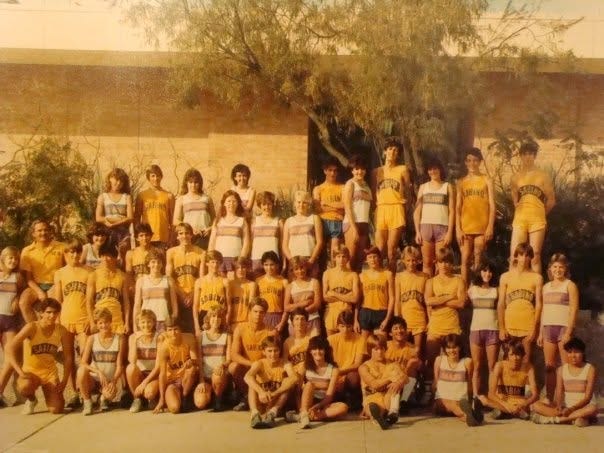
Mr. Brooks told us that when he started at Sabino, his family had only one car, so he’d leave the car for his wife and newborn, taking the bus as close to school as he could and running to school and back. 5-6 miles a day.
I admire how selfless he was to take care of his family, doing everything he could for them. Then I remember how selfless he was with all of us, running with us every day to be sure everyone got back to school safely.
We all wanted to be great for him. Like he was for us.
Not everything was perfect, though.
My heart still crumbles thinking about the time Mrs. Solomon made me stand up in front of the entire 6th grade class. I’d told a kid he smelled like shit. She made me apologize to him in front of the whole class. Not only apologize, but repeat what I said in front of my friends.
I was mean to him just to be mean. A bully. The best version of myself was often absent and silent. Chaos at home had become a cry for help at school.
When I was a freshman, some of my friends and I found a bottle of vodka at a neighbor’s house. Of course we drank it. Sadly, it was the same day as the school's end-of-season track party. Not only did I show up late, I showed up ugly drunk. I have vague, blurry memories of Mr. Brooks and other coaches walking me outside, their sad eyes and angry voices scolding me, ‘this is not the place to show up drunk off your ass, Tim,’ and sending me home.
As a senior, I asked Mr. Brooks about it. He nodded, saying he remembered. To this day, I can still feel the shame and sadness of that moment.
Gardens change with the seasons. Mine did, too.
I was surrounded by gardeners during my most formative years—at school, in athletics and among friends.
Once I left the garden, the weeds came roaring back. Ron Scholl’s lessons, family history and a young man’s stubbornness took root. The path Mr. Brooks and the others had tended became cluttered and unclear.
It would be a long, barren time before I could see a way out.
Eventually my life became slamming doors and separate beds. Nobody wanted to live at home. I’d found myself at the bottom of a hole I’d been digging for years. I was looking up for somebody to blame. It was me. I was to blame
Then a group of friends asked me an unexpected question.
“Bentley, you want to run a half-marathon?”
“What? No!” I remember thinking. “That’s about 13 more miles than I’d like to run.”
My self-esteem was so low it wouldn’t let me hear the real question. I thought they were making fun of me because I hadn’t run in years. If I’d listened, I might have heard what they were really asking. They needed someone to run with them. Someone to help them train. Someone who’d been there before.
When I finally answered, "Yes, I'll run with you," my heart sank and jumped at the same time. I hadn't run in years. What if I couldn't do it? What if I let them down?
You can’t just show up and run a half-marathon. You have to train. Even if it’s only for a few days. So we did. Each run peeled away years of shame I’d buried deep inside me. Quitting the team. Letting Mr. Brooks down. Becoming someone I no longer recognized.
Then something unexpected happened.
Getting ready for each run, I found a familiar rhythm. The breathing. Feet hitting the path. Endorphins flooding my brain. I remembered the days in Mr. Brooks' garden. "Good job, Timothy."
Shoes lined up the night before. Clothes laid out. Yogurt, granola and orange juice. My stomach was doing flip-flops. I wasn’t going to win. Not even close. But it felt familiar.
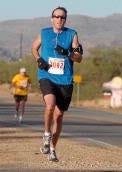
As I crossed the finish line, I recognized something I hadn’t felt in years. Somewhere beneath the overgrown weeds, something Mr. Brooks had planted was still alive.
There was a path.
I think I’m narrowing in on the theme of my book. And by book, I mean I’m still thinking about it. I need to be sure I’m not scheduled for 3rd period PE.
I always wonder if "safe Sarah" has any interesting stories to tell. I am always touched by yours. Good job, Timothy.
This post actually brought me to tears. Thank you for sharing this it gives me hope.